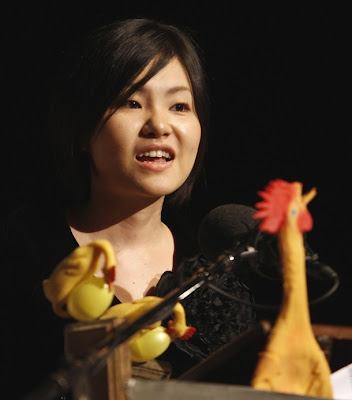
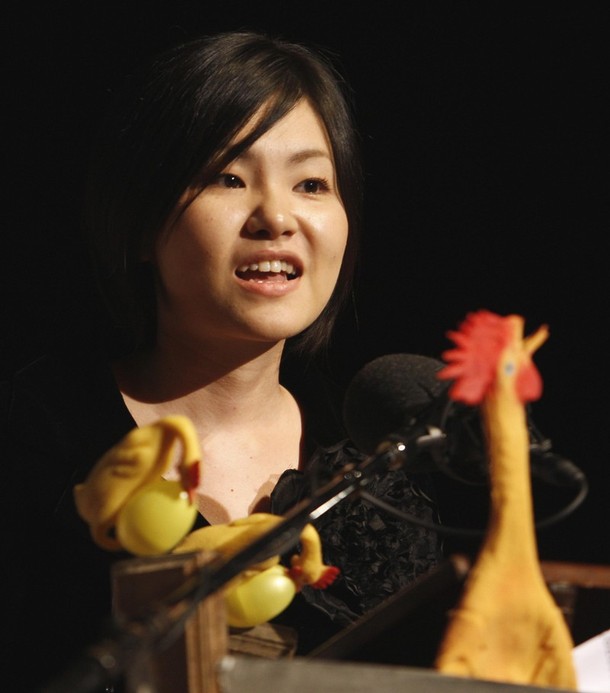
Above is a picture of Japanese Chemist Mayu Yamamoto, accepting her 2007 Ig Nobel Prize for Chemistry.
Ig Nobel prizes are awarded every year to great thinkers all around the world for improbable research. Mayu Yamamoto received her prize for inventing a new process that could produce vanillin, a key component of vanilla fragrance and flavoring, at less than half the cost of the original vanilla bean extraction process. Here's an excerpt from her acceptance speech.
"Thank you. Please imagine what kind of smell you get when cow dung are heated. Can you imagine that? It is very strange and sweet. Please eat ice cream with cow dung. Thank you."
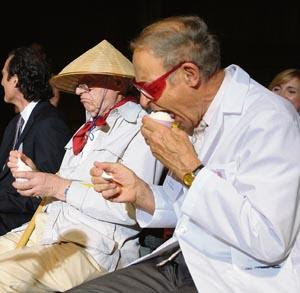
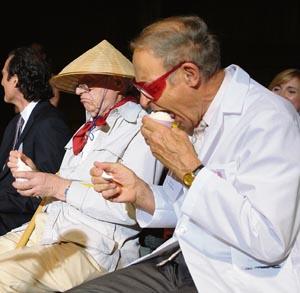
Thats right, Yamamoto produces vanillin out of cow dung. A one hour heating and pressuring process transforms excrement into the sweet smelling chemical, which can be used in shampoo, perfumes, or food products. Toscanini’s Ice Cream in Cambridge Massachusetts has even named a new flavor in honor of Mayu, Yum-A-Moto Vanilla Twist. To the right is a photo of Yamamoto's fellow Ig Nobel Laureates sampling the new flavor.
Since the inception of the Ig Nobel Prizes, there have been 13 Japanese award winners. Here are some of the most notable Japanese winners, directly from the
Improbable Research past winners sitePEACE
Keita Sato, President of Takara Co., Dr. Matsumi Suzuki, President of
Japan Acoustic Lab, and Dr. Norio Kogure, Executive Director, Kogure Veterinary Hospital, for promoting peace and
harmony between the species by inventing
Bow-Lingual, a computer-based automatic dog-to-human language translation device.
BIOLOGY PRIZE: Fumiaki Taguchi, Song Guofu, and Zhang Guanglei of Kitasato University Graduate School of Medical Sciences in Sagamihara, Japan, for demonstrating that kitchen refuse can be reduced more than 90% in mass by using bacteria extracted from the feces of giant pandas.
COGNITIVE SCIENCE PRIZE. Toshiyuki Nakagaki of Hokkaido University, Japan, Hiroyasu Yamada of Nagoya, Japan, Ryo Kobayashi of Hiroshima University, Atsushi Tero of Presto JST, Akio Ishiguro of Tohoku University, and
Ágotá Tóth of the University of Szeged, Hungary, for discovering that slime molds can solve puzzles.
PEACE
Daisuke Inoue of Hyogo, Japan, for inventing karaoke, thereby
providing an
entirely new way for people to learn to tolerate each other.
CHEMISTRY
Takeshi Makino, president of The Safety Detective Agency in Osaka, Japan, for his involvement with S-Check, an infidelity detection spray that wives can apply to their husbands' underwear.
BIODIVERSITY
Chonosuke Okamura of the Okamura Fossil Laboratory in Nagoya,
Japan, for discovering the fossils of dinosaurs, horses, dragons,
princesses, and more than 1000 other extinct "mini-species," each
of which is less than 1/100 of an inch in length. [REFERENCE: the
series "Reports of the Okamura Fossil Laboratory," published by
the Okamura Fossil Laboratory in Nagoya, Japan during the 1970's
and 1980's.]
ECONOMICS
Akihiro Yokoi of Wiz Company in Chiba, Japan and Aki
Maita of
Bandai Company in Tokyo, the father and mother of
Tamagotchi, for diverting millions of person-hours of work into
the husbandry of virtual pets.
BIOLOGY
T. Yagyu and his colleagues from the University Hospital
of Zurich, Switzerland, from Kansai Medical University in Osaka,
Japan, and from Neuroscience Technology Research in Prague, Czech
Republic, for measuring people's brainwave patterns while they
chewed different flavors of gum. [Published as "
Chewing gum flavor
affects measures of global complexity of multichannel EEG," T.
Yagyu, et al., Neuropsychobiology, vol. 35, 1997, pp. 46-50.]


 Thats right, Yamamoto produces vanillin out of cow dung. A one hour heating and pressuring process transforms excrement into the sweet smelling chemical, which can be used in shampoo, perfumes, or food products. Toscanini’s Ice Cream in Cambridge Massachusetts has even named a new flavor in honor of Mayu, Yum-A-Moto Vanilla Twist. To the right is a photo of Yamamoto's fellow Ig Nobel Laureates sampling the new flavor.



 Stumble this site